
Breaking Up With ChatGPT Was Just the Beginning
A real-time update from 5-weeks of trying to defund fascism


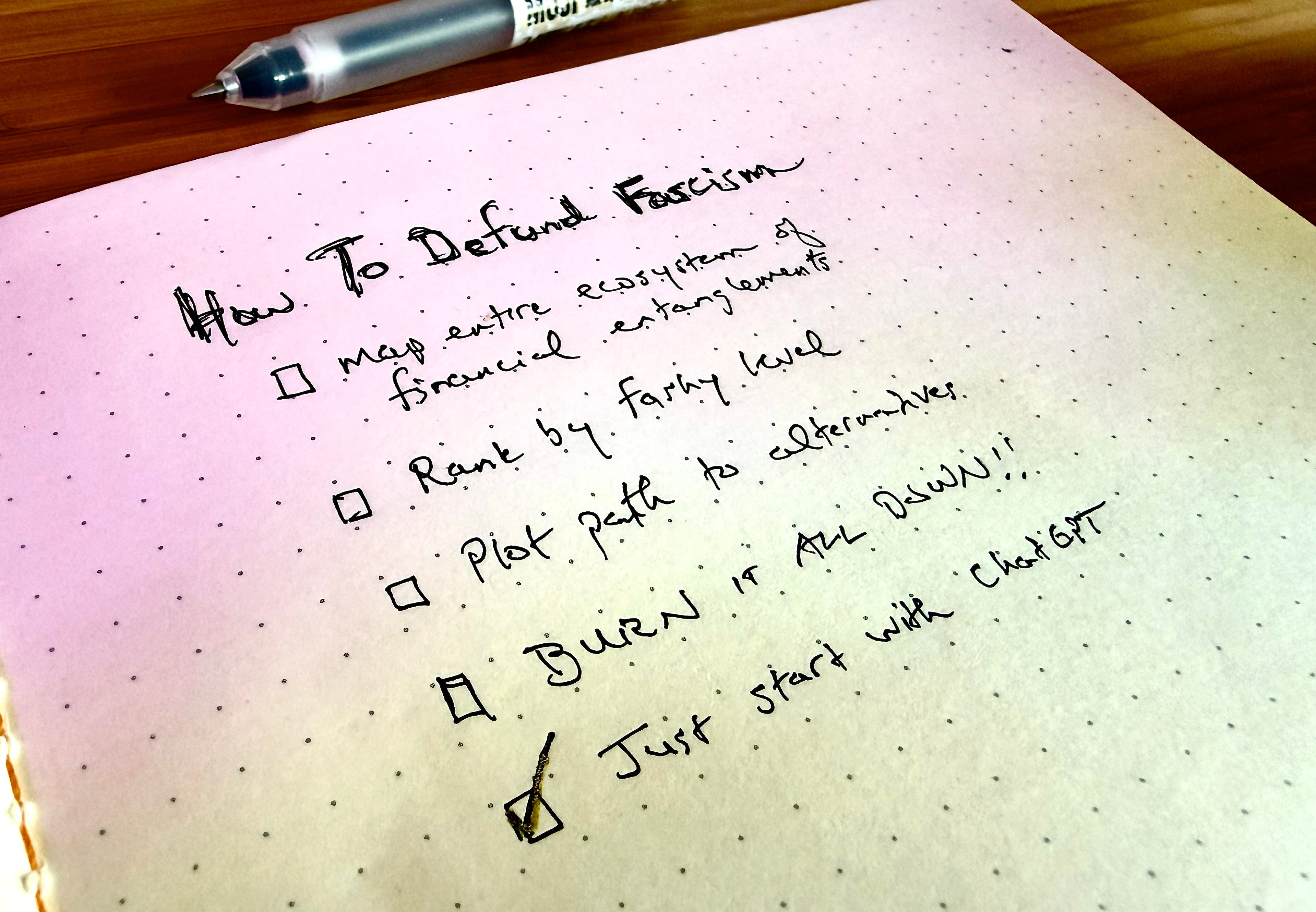
Hi you,
So this is kind of a diary entry of my efforts to “defund fascism.” It’s less the polished version, more just…what’s actually been going on.
You can scroll on to read the update or feel free to listen to the uncensored voice note version of this post (full of feelings and swear words).
I’ve been at this for about five weeks now, the project I’ve been calling my defund journey. The idea is pretty simple even if the execution isn’t: I want to redirect what I think of as the DAM—my data, attention, and money—away from the platforms and companies making the world worse, and stop letting that current flow in directions I didn’t consciously choose. And then figure out where to actually plant seeds, not flags. I’m not interested in planting a flag, making a declaration, and moving on. Seeds require tending. They’re a commitment to something growing over time. (Can you tell I’m working on decolonizing my own mind and language? It’s hard but fun!)
When I first got fired up about this, I had visions of spreadsheets dancing in my head. Notion pages. Decision trees. I was going to build the Mother Of All Tables (a MOAT), sorted by fascist complicity, federal contracts, every naughty list I could find. Then, with that comprehensive map established, I would feel comfortable starting the journey. Very Virgo. Very overkill. What actually humbled me was just working on one thing at a time.
The ChatGPT migration
Breaking up with ChatGPT has been way bigger and way gnarlier than I expected. That’s where most of my hours have gone these past five weeks. The business account I shared with my assistant—cancelled, auto-pay off, neither of us really using it anymore. My personal account still has the $20/month running because I’m being careful about the data transition (more on that later), but the attention and data are gone. I killed the DA. The M is next.
I didn’t expect what the migration would teach me. I came in wanting to copy every single chat log over, and Claude basically said: you don’t need to do that. It’s about distillation, not total migration. Keep what matters, leave the rest. That’s actually a pretty good operating principle for this whole project.
By the way…
We created a little gift to help you take that first step. Our AI Go Bag bag is an easy, step-by-step guide to migrating from ChatGPT to Claude and taking your essential data with you (it’s yours, if Sam Altman can have it…so should you!).
Just subscribe to the newsletter, and get it for free as our welcome gift!
Here’s roughly where things stand:
Done or in progress:
ChatGPT business account: cancelled. Personal account: money still running but attention and data redirected.
Amazon: still a Prime member, but the mental pole position is gone. I’m thinking less last-minute, buying less overall, and the money is way down. Kindle is next, but that’s a harder goodbye—I’m planning to shift my library to Calibre and Libby (with audiobooks to Libro.fm) and eventually swap the hardware for a Kobo reader.
Apps and location services on my iPhone: did a full audit, found some ugly stuff (more on that below), made changes.
Shopping locally: actively choosing it, exploring it, finding it genuinely good for my soul.
Travel: back to public transit when I can. Subway from the airport. Local taxis. Less carbon inside cities, more human contact.
Not touched yet:
Google. It’s everywhere—every project, every collaboration, fifteen people in shared docs across multiple organizations. That’s a collective migration, not a personal one. I know what it would take and I’m not there yet. Not-so-secretly hoping the company gets divided into more competitive entities for the betterment of all before I start moving lol.
Amazon Prime membership formally: still running. Cancellation pending me actually making the Virgo checklist.

The internet situation
This is where it gets personal.
I’m a broadband nerd. I believe symmetric data speeds are a sign of civilization and anything less is basically a human rights violation. When I lived in LA I had Sonic, fast independent fiber. People would come to my house just to upload files. I lived in the future.
Then I moved to Palm Springs and I live in America now. 1Gbps down, 40 megabits up. I feel my pixels degrading on every Zoom call. I don’t want people to see me like this!
So when I did an audit of my apps, I was already primed to care about this stuff. And I found something gross. The Speedtest app I’d been using constantly for years turned out to be owned by Ziff Davis/Ookla, which had become a major ad network and data broker. Every test I ran, they were logging my location and selling it to enterprise companies to target me. I should have known. I switched to SpeedSmart, I pay for it, and I feel cleaner. Ziff Davis then sold the whole property to Accenture so enterprises can use all that data to optimize whatever rapacious thing they want to optimize…good timing on getting out.
The VPN I was already using turned out to be solid. No logs, no required account, no credit card. They can only snitch with what they know, so the less they know, the better.
And then there’s the bigger project, which is actually trying to fix my internet situation at home and get free of Spectrum. I’ve been working on this for about five years. I’ve talked to the provider, I know what they need to light us up with fiber. Now I’m slowly going door to door with my neighbors—most of whom are older and don’t particularly need screaming upload speeds for their media files. So there’s a whole sales pitch happening. I’m leading with resale value. We could be the envy of the town. It is very slow. But it feels like the right kind of slow—collective, local, actually trying to build something rather than just consume differently. Check with me in six months to see if I’m still sounding patient.
The thing at the shop
This one didn’t involve any money at all, and it’s the one I keep coming back to. I was in a local store and saw a product I wanted to photograph and post online. Before I did, I asked the owner if that was okay. He lit up. Told me what he actually hates is when other shop owners come in, take pictures of stuff he flew to New York to source, and then sell it cheaper online without so much as a finder’s fee. He said: yes, please tag us. We both walked away feeling better. I didn’t buy anything. No dollars changed hands, but something did.
When I’m buying random stuff off Amazon, nobody feels better: not me, not the drop shipper grinding it out on the other end. We’re just both running the machine. This was different. I looked a human in the eye, asked consent for something that implicated them, and got to actually know them for a minute. That counts for something. I think it counts for overnight shipping, at least.
Now it’s your turn: what have you been up to? What’s been easy? Which goodbyes have felt hard, or even impossible? And has anything uniquely human happened to you along the way?
More dispatches from the defund journey to come.
–Baratunde
Thanks to the Life With Machines team, Layne Deyling Cherland and Alie Kilts in particular, for editorial and production support.
I found that when I turned off Audible and Kindle, I spent much less. I buy fewer ebooks and audiobooks now. I read what I can, and listen to what I can, on Libby. I am more selective about what I buy, and I enjoy those more now. I use Kobo and Libby. If something is very very very old, I check Gutenberg.org.
I quit using Home Depot, opting for a local hardware store instead. It is closer, and the staff are very helpful. I just had to change my mental habit, to thinking first to go to the locally owned hardware store. I feel like I'm more a part of my town now. I save fuel going there (actually a KIA e-car), and it's less hectic.
Amazon was easy during the pandemic. Now, I find it less reliable, too fill of junk, and not really a bargain in most cases. I got into the habit of planning shopping trips and writing things down. Without really trying, I quit using Amazon completely.
The switch from WaPo to The Guardian was a no-brainer. I didn't mind at all.
Other things are the same way. I had to re-learn pre e-commerce habits. I'm glad I do that now. I feel less isolated.
I'm using duckduckgo as browser and search engine. I think it's cleaner and safer than the bigger ones, and the ad content is way, way less. I turned off the ai in the settings.
Love every bit of this B. Starting a somewhat similar protocol but going to take some notes from you!