
Date Farms, Not Data Centers!
What a desert tech conference taught me about our future with machines


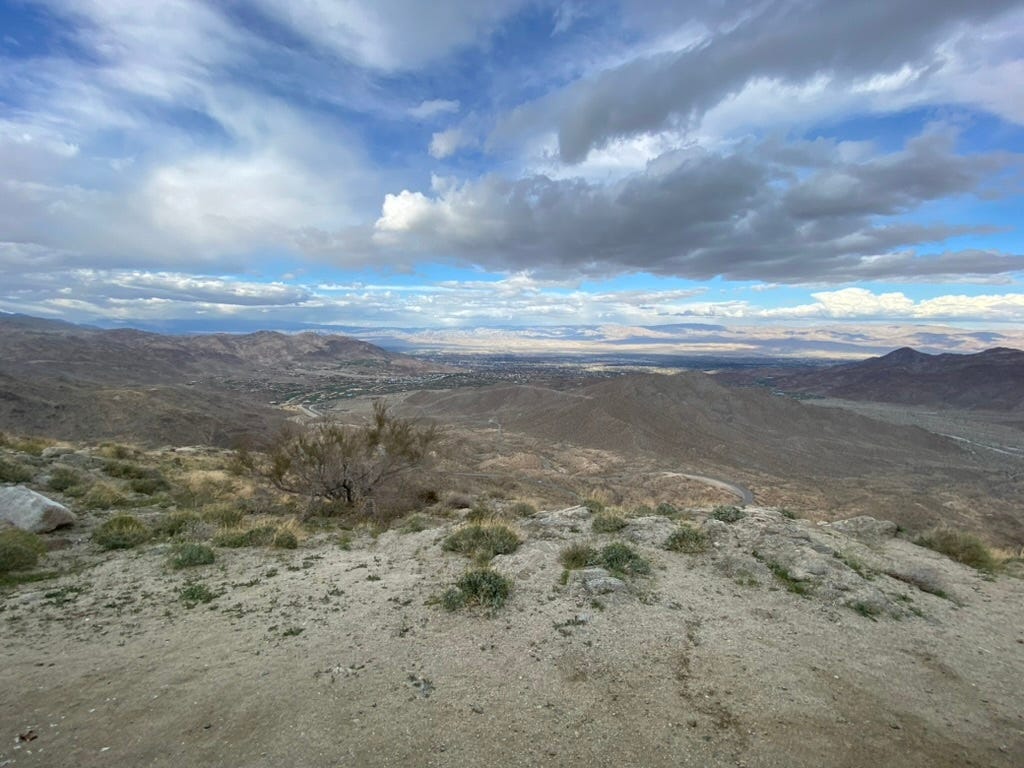
At the end of June, I opened a tech conference in my hometown of Palm Springs by asking a few hundred people to make some noise if they felt dread about the future.
The room got loud.
Then I asked who felt excited. The room got just as loud.
That is the moment we are in: emotionally stretched, confused, and toggling between hope and horror at the speed of a fiber-optic connection. But over those two days at the Palm Springs Convention Center, we decided to stop letting the tech lords define the terms.
This was our second year gathering in the desert, but we made a deliberate change before doors opened. Last summer, we called it the Palm Springs AI and Creativity Expo. This year, we renamed it PS/NExT: New Experiences in Technology. Why? Because we wanted a more expansive goal. The conversation has already outgrown the narrow hype of chatbots. The forces shaping our future are intensely physical and deeply local. We wanted to look past the virtual noise to the actual tech that affects our everyday lives.
We began by acknowledging where we were: on the sacred land of the Agua Caliente Band of Cahuilla Indians, who have stewarded this fragile desert ecosystem for over 8,000 years. Having Tribal Council Vice Chairman Anthony Purnel open our gathering set the spiritual, emotional, and psychological orientation for everything that followed. Hearing from the first people of this valley gave everyone in the room a profound, living lesson in what long-term stewardship actually looks like.
With my opening remarks, I wanted our community to carry a fundamental question over those two days. Beyond asking how a specific tool works or how to speed up our lives and business operations, we need to ask: how do we want to live? How do we want to feel with our neighbors, our teachers, our kids, and the local businesses that mutually sustain us?
The Battle Down the Valley: Who Decides?
Everything sold to us as “digital” and “virtual” eventually lands in the physical. It lands on a piece of land, in a body of water, or in the literal grid of a community.
And just a few weeks before the conference, we watched this play out in a massive way down the valley in the city of Coachella.
Out-of-town developers under the name Stronghold Power Systems tried to fast-track a monstrosity: a 450-acre hyperscale data center called the Coachella Valley Technology Campus. They did it quickly, with little public input at first. The project advanced under former Mayor Steven Hernandez, who resigned this spring after a felony guilty plea to a conflict-of-interest charge, and whose campaign had taken donations from Stronghold.
But the community stepped up. In 116-degree desert heat, hundreds of residents, farmers, students, and elders showed up to city council meetings week after week. I watched hours of these meetings, and let me tell you, it was better than Netflix with impact far greater than passive media consumption. From stage at the conference I invited those local activists to stand and be recognized, and the room applauded for them.
At those public meetings yes, there were a few clowns, but 90 percent of the people who spoke did so with deep love, research, and commitment to their home. They out-studied the official experts whose job it was to do the studies. They stood at the podium and demanded a reversal of this deal and a ban on future ones, refusing to let our precious, scarce desert water and power be exploited just so some tech company could extract the vast majority of the financial benefits.
As one local resident beautifully put it at the podium:
“Date farms, not data centers!”
On June 4, 2026, the Coachella City Council felt the heat and terminated the developer agreement, passed a 45-day urgency moratorium on all data centers, and is currently working toward a permanent ban. It was a resounding, beautiful demonstration of democracy in action. When people show up, stand in the heat, and refuse to accept the corporate script, we get to decide our future. It’s not “AI is taking our water” or “AI is building a technology campus.” Humans are making these choices, and in Coachella, the humans said, No, thank you.
Just last night, the neighboring city of Indio voted unanimously to move forward with a ban on data centers. Follow and find out more at NotInMyValley.org
Neighbors Helping Neighbors (The Vibe-a-thon)
That same spirit of collective agency filled the convention hall, thanks in large part to my friend, neighbor, and LWM Special Envoy to the Machines, Peter Loforte. Peter spent his professional life in tech, saw the automation wave coming, and decided to do something different. Instead of launching another Silicon Valley startup to sell enterprise software and lifestyle peptides, he asked a much simpler question: How can I help my neighbors prepare?
One of the highlights of what Peter built was the Vibe-a-thon.
Instead of a traditional hackathon where developers build speculative apps for venture capital (or demoralized and surveilled Meta employees are forced to hack in their "free time” for their billionaire overlords), this vibe-a-thon invited local organizations to bring their real, messy tech challenges to the table.
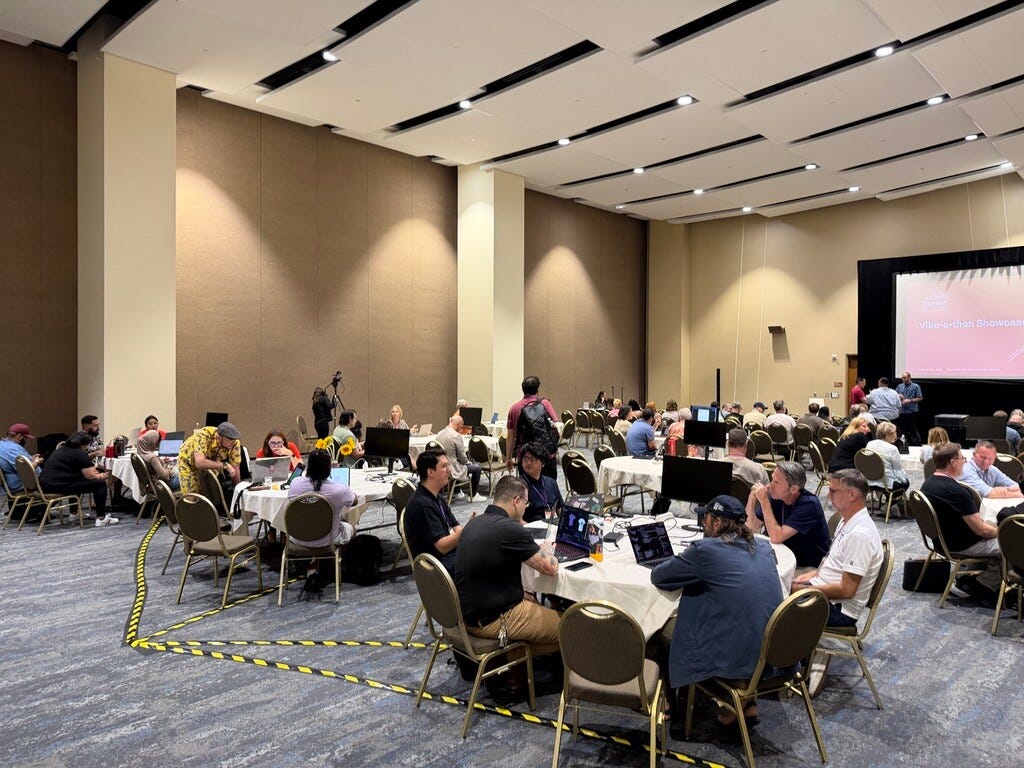
The Living Desert Zoo was drowning in a mountain of unstructured paper invoices, requiring hours of manual data entry. The team from Visit Greater Palm Springs was struggling with project management, using Basecamp but desperately needing cross-departmental dashboards and timeline views that weren’t natively supported. A sustainable T-shirt company was losing hours to manual design work, dragging and dropping image comps in Photoshop to share with clients.
For each of these, a table of their neighbors sat down with coding tools and AI to build and automate the solutions. On the spot. This is what tech looks like when it isn’t extractive. It’s neighbors handing other neighbors working tools to make their lives a little easier. See more about the vibe-a-thon.
The Human Proximity Ladder
We had over 50 speakers across 46 sessions, but the keynote that stole the show came from Dr. Eric Leroux of Eisenhower Health, right here in the valley. He is their Chief Medical Officer and Chief Quality Officer now, but he came up as an emergency physician and founded Eisenhower’s trauma program, so he has stood in both the exam room and the boardroom. He is also a builder, the founder of Curbside Health, a digital health venture aimed at better medical decisions.
Two of his points have stayed with me. First, human care comes first. As we build the future, we have to fiercely protect real human connection in our services and our businesses. Technology should assist us, not replace our humanity. Second, it is okay to be cautious. New tools always move faster than our ability to trust them, so stepping back to ask hard questions is not fear. It is normal, and it is healthy.
As a fan of frameworks, I also love that he offered what he calls the Human Proximity Ladder. At the low-stakes bottom, the machine does the work and humans verify it. At the high-stakes top, the machine can prepare, but a human still has to show up. The higher the stakes, the closer the human stays.
In conclusion, the more the machine can do, the clearer it becomes what only we can do.
Real Tech for Real Problems
We also hosted a showcase of BASEstud.io, a climate infrastructure company founded by Heidi Adams, who lives and manufactures right here in the valley.
BASE Studio is converting regular streetlights into distributed energy resources: solar-powered lamp posts equipped with batteries that store energy, stabilize our local grid, and distribute Wi-Fi. More of this please!
This is the exact opposite of the massive, centralized, and extractive power concentrations of Silicon Valley. It’s decentralized infrastructure that solves real-world climate and energy problems for everyday people, built on a human scale.
Defining the Circle
To wrap up day one, I brought a card game (yes, physical cards) called The AI Effect, created by our friends at The Rithm Project, to the main stage.
I read scenarios out loud to a room of 600 people: like whether you’d let your chatbot talk to your partner’s chatbot to resolve a relationship conflict. We had people raise their hands, and we ran microphones around the room to let folks explain their choices. It got people talking about their deepest fears, excitements, and confusions, warming them up to have a real, unvarnished conversation about the future. After that, people played among themselves at the hall's round tables. It was a fun way for neighbors to actually get to know each other while wrestling with this contentious topic. All this segued into a panel about the costs, including environmental, of AI.
The conference was by no means perfect, but it's one of the best examples I've seen of putting the future on a collective agenda for the people themselves to engage in. We aren’t here to pretend everything is perfect, and we aren’t here to pretend we are doomed. We are here to accept the responsibility that the future is up to us.
As my friend Ted Tremper at the Creators Coalition on AI says: “The future is not inevitable. We decide.”
I left the valley with a line from a poem I wrote a couple of years ago that still feels like the only blueprint worth following:
I do not want to be kept in the loop.
I want to define the circle.
Help Us Tell These Stories
What’s happening in the Coachella Valley is a portable blueprint for true collective agency. While the mainstream media defaults to stories of corporate AI battles, we are focusing on the ground-level reality of how communities are reclaiming their sovereignty.
We are partnering with the Creators Coalition on AI (CCAI) to document and share these models of community-first technology. Stay tuned here for more and reach out if you're down to collaborate. partnerships@lifewithmachines.media.
Let’s build a future that doesn’t suck, together.
— Baratunde
Thanks to the entire Life With Machines team, especially Layne Deyling Cherland and Alie Kilts for editorial and production support.