
Superficial Intelligence: Replace Your Spouse
A *totally* sincere response to household robots


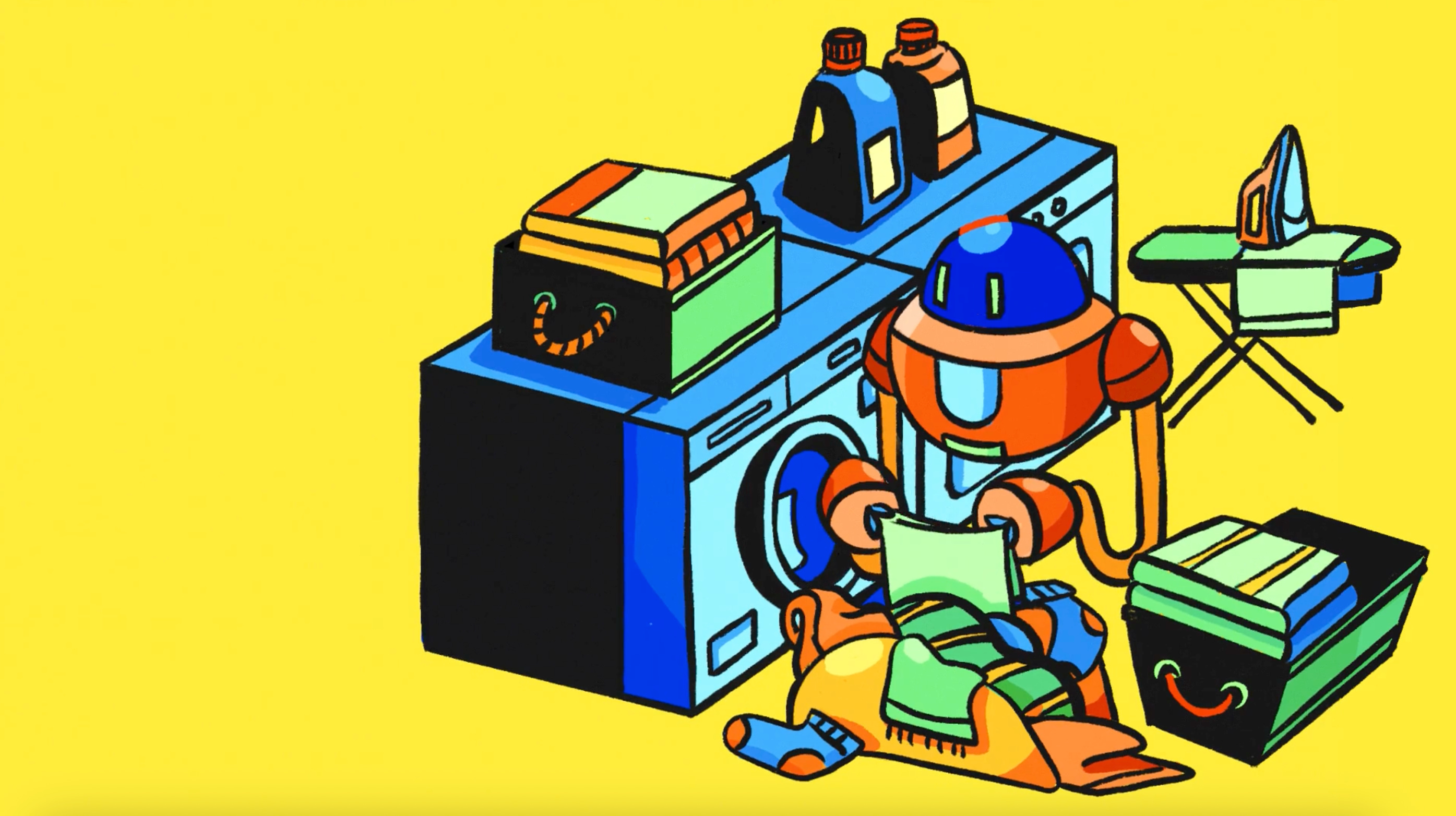
My spouse wants to get one of those humanoid laundry-folding robots for our home. I don’t see the point and I worry that it’s a waste of money on something so frivolous. What should I do?
— Fine With Folding, Washington State
Dear Fine With Folding,
Folding laundry is a waste of human time. On this, you, your spouse, and I agree.
Right now, a human with a smartphone strapped to their forehead is being paid up to $25 per hour to fold laundry on camera so a machine can learn to do it. That’s the old, slow, expensive way of training laundry robots.
The new way is you. With the laboratory work largely done, the only thing between our nearly perfect robotic companions and total mastery is a minuscule amount of data gathered in a real home, doing real laundry, for a real family. Your spouse is opting you in to co-build the last mile of physical AI infrastructure, co-author the future, and, of course, co-fund it.
For women in heteronormative relationships, a laundry-folding robot would take on a significant amount of the unpaid, unbalanced domestic labor women are expected to do and almost certainly reduce household friction. But there’s a far more compelling reason to bring one of these sensor-packed, internet-connected devices into your home: the automation of human physical and cognitive labor at scale, generating unprecedented wealth.
The folding is just the beginning.
We already have machines that wash and dry our clothes. One that also folds is the least ambitious thing your spouse is offering you.
Consider the time involved. The average American spends 5 hours a month doing laundry, and considerably more than that deciding what to wear. That time will be returned to you to spend on higher-value behaviors such as rest, employment, and making more purchases.
But laundry is not only a waste of time. It is a waste of space, and robots will eventually solve that problem as well. Each American devotes roughly 100 cubic feet of their home to storing clothing. Nationwide, that is over 30 billion cubic feet of housing surrendered to textiles. The solution is obviously to install an additional machine, most certainly in development by an enterprising company, to vacuum-seal your dried clothes into compact cubes and reclaim 80 percent of that space.
When it is time to get dressed, browsing a screen beats browsing a closet. In the near future, you’ll be able to log in to your Virtual Closet. No more sifting through drawers or buttoning and unbuttoning shirts. When you’ve made your selection, an automated process retrieves, decompresses, steams, and presents your chosen outfit. Voila!
But why stop there? For an additional monthly subscription, the next release will offer Active Selection Mode which chooses for you. It will account for weather conditions, read your calendar, and avoid repeating recent looks. When your smart toothbrush registers a surge of negative self-regard based on changes in your hormonal measurements, the system will know not to select anything too form-fitting. Most people lack the aesthetic talent to choose their own outfits. Soon, the hours once lost to considering and deciding will be yours again to re-deploy.
Once the closet is fully virtual, why own clothes at all? A premium subscription to the forthcoming Infinite Closet will eliminate the final remnants of space wasted on home clothing storage. If you bought the Compaction Cube System, fear not: it will easily be reprogrammable to compress any other substance your household produces in excess. Americans already store billions of cubic feet of belongings in self-storage, so I expect the transition to regional wardrobe distribution centers to be met with the same enthusiasm as the expansion of data centers. Today’s leading clothing rental service, Nuuly, keeps 90 percent of its customers past the first year, which is the highest form of consent we have.
Just moments ago, you were worried your spouse would waste money. I trust you now see the sensible, high-return investment this robot will end up being.
A brief note on the state of the art. Your robot will be excellent, but when it meets a garment it does not understand, a human may briefly take remote control. Do not be alarmed by the thought of a stranger handling your most intimate items or scanning your bedroom. The data your robot collects is exactly what will, in time, free that person from having to watch. See it as training your own privacy back into existence.
Eventually your robot will know more about you than you know about yourself. And since no human can make the best decisions for themselves once infinitely upgradeable intelligence is available as a service, your robot will decide. Which brings me back to your current spouse.
When you chose each other, you lacked relevant information. This was not your fault. It was a failure of technology. But an always-on, cloud-connected, humanoid robot will meet whatever needs your spouse was meeting, and then some. That your spouse wishes to buy this machine for you may be the highest and final contribution they can make to your relationship.
Your cohabitation is itself a form of theft from the economy. Two people living separately generate far more measurable economic value than the same two living together. Netflix faced the same threat with password sharing. It rebranded the behavior as “paid sharing” and added roughly 50 million subscribers. We must likewise evolve from unpaid cohabitation to paid. Apply that logic to everything else and you begin to see the future.
Your robot will fold. Your robot will dress you. Your robot will think for you. It will order your dinner too, delivered by the very person who once taught it to fold. Everyone is paid. Everyone is optimized. No one has to touch anything.
In short, get the robot, and ditch the spouse.
This is the second installment of Superficial Intelligence, my new satire column in collaboration with Mozilla Foundation and The Onion. Check out the first one below:
